| Meter
Details |
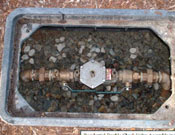
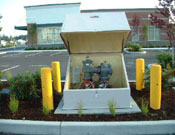
Read your meter and pictures of meter / backflow
installations.
|
| The
Basics: |
|
|
What are the
business hours for billing questions?
Monday through
Friday, from 8:00 AM until 4:30 PM (closed on Holidays and weekends). Night Drop,
anytime.
Who
owns Summit Water?
The property
owners in the franchised service area of Pierce County that is in the general
Summit/Waller area who have chosen to use the services of the corporation. It is
a Not-for Profit corporation, "Group A" water system. The corporation
is governed by the articles of incorporation and the By-Laws of the corporation.
|
| Methods for making payments |
|
|
Methods for
making payment for water service?
Payments may be
made in person at the Summit Water office, or by cash, check or money order in
the self-addressed return envelope with your statement, that you can drop in the
mail. In addition, for your convenience, you may also drop your payment in the mail
/ payment slot on the left-hand
side of the office front door.
|
| Back to Top |
What about
direct payment from my bank?
Yes, ACH payment
from your bank may be applied for in Summit Water's office.
|
|
What about
credit card payment?
Yes, major credit
card payment, (Visa, Mastercard) can be used in the office with proper
identification.
|
|
What is a UNIT
on my bill?
One (1) unit is
100 cubic feet, which is 748 gallons. I.E. one cubic foot is 7.48 gallons. If
you are looking at your meter, one revolution of the sweep hand (looks like a
second hand on a clock) is one cubic foot or 7.48 gallons.
|
|
Do you bill
monthly for water service?
Residential and
small commercial class customers are billed every two months (bi-monthly).
Larger commercial and irrigation customers are billed monthly.
|
|
What are the
charges for water service?
Customers are
charged based on the class of customer, the meter size, and the amount of water
measured through the meter (Go to the "Doing Business with Summit" and
then to the "Rates & Billing" web page for details.
|
|
Why is the
property owner responsible for the billing on a water service?
The services of
Summit Water, to be in compliance with IRS regulations, are only provided to its
members. Summit will send a bill to the tenant or occupant of a members property
as a convenience to the member. We do not take deposits toward a water service
bill. The by-laws of the Company state it is the member's responsibility for all
services provide and for damage caused by the occupant of a property.
|
|
Will Summit
Water bill tenants?
Summit will bill
the service address or the member, based upon a request by the member. A change
on the account may only occur at a request by the member. The member is still
responsible for the bill.
|
|
Late,
Delinquent and After-Hours Turn On Fees:
Late
Fee - $10.00
Delinquent
Fee - $45.00
After-Hours
Turn On Fee - $30.00
|
| Meters: |
Where is
my shut-off valve?
You may not have
one, not all homes do. If you have one it may be located, in the garage, or
directly outside the house (possibly buried inline with your outside hose faucet)
and the meter box. It could also be located in the
basement or a hallway closet. We hope you are checking ahead of time and not
during an emergency!
|
| Back to Top |
In the eastern
part of the U.S. the meter is located in the basement. Where is my meter
located?
It varies. Most
of the time it is in line with an outside hose bib. Normally it is located about
3 feet inside the property from the right-of-way line. Sometimes they are
installed on easements next to the property. Our weather does not get
that cold that the meter must be located indoors. We do not open the meter box
if the temperature gets below freezing for any period of time.
|
 |
I want to know
how much water I use in a day, how do I read my meter?
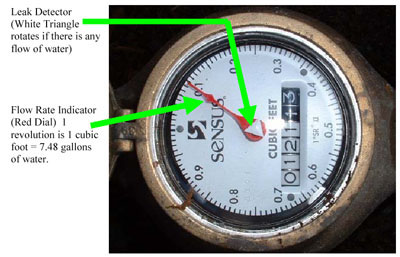
The meters are
digital. Just read them left to right. Read all the same colored numbers and
you'll have the read. Some are three digit reads and some are four digit reads.
There is also a sweep hand, and one time around is equal to 7.48 gallons. The
small triangular hand is know as a "leak" or flow detector, and will
move even for a minute volume of water flow.
|
|
Can I turn the
water off at the meter, I need to change my faucet valve?
We
will do it for you since the shut off valve is ours. Presently we
do not charge for this service during our regular business hours. You should
have a shut-off valve between the meter and your faucet valve. Please give us a
call for assistance.
|
| Leaks: |
|
 |
How do I check
for a leak?
Turn off all
water connections inside and outside the house. Check for any flow in the toilet
bowl. Then go out to the water meter and check to see if the "leak"
flow detector is rotating (usually a small triangular shaped hand or pointer).
If it is rotating slowly, you may have a small leak. If it is rotating fast,
then go to the next step. Look at the sweep hand, is moving? If it is you may
have a leak. If it is moving constantly, you can place something as a reference,
or just pick a spot on the outside dial, and time with a watch that shows
"seconds", and time how long it takes to do a few revolutions. One
revolution is equal to 7.48 gallons. Hint, if it starts and stops over a period
of time, it just may be the toilet flapper. We have dye tablets here at the
office, that you may have.
|
|
You left a
note that suggests I may have a leak. I don't know of anything that is leaking.
Where do I start?
We can check for
you at the meter when someone is present at the home or business. If you want to
look for yourself, Go to the section on HOW do I check for a leak.
|
|
I can hear
water running in the house, but I don't see any leak, what's the problem?
Check your toilet
tank flapper valve. The material used for the flapper on some toilets gets soft
and changes shape, allowing the water to seep slowly into the bowl. The noise
may be caused by the slow flow through the tank refill valve. Check the
"leak" flow detector on your water meter.
|
|
I must have my
water shut off out at the road, and the office is closed. Now what can I
do?
Please give us a
call at 537-7781, listen to the menu for the number of the on call person for
after hours, weekends and holidays.
|
|
My pipes are
making a banging noise that I haven't heard. Did you do something?
It could be that
the expansion risers (hammer arresters) on the pipes going to the fixture have
filled with water over time. When a valve is operated quickly, such as a lever
type faucet, a dishwasher or washing machine solenoid valve, then "water
hammer" or a shockwave is setup and moves the pipes. If we have replaced
the service during a water main replacement project, or a service replacement
and there was not a check valve at the meter, then there could be the banging
noise. All residences, by plumbing code, must have a pressure tank located on
the cold water side of the hot water tank. The problem could be ours. Give us a
call and we can check our system first. You can check the items we have
mentioned above, prior to calling us, so that we can try and trace the problem
ASAP.
|
| Requirements: |
|
| Back to Top |
What is
required by Summit Water if I want to install an irrigation system in my yard?
Summit Water does
not require a permit, but you must file with Summit Water a certified backflow
report.
The backflow assembly must be installed according to the policies of
Summit Water. See policy
6.19 for existing services.
There may be permits required by the
Pierce County Buildings Division.
|
|
What are the
business hours for new construction or project questions?
The business
hours are 8:00AM to 4:30PM, Monday through Friday. There is voice mail, fax and
e-mail for after hours.
|
|
Who do I
contact if I want to dig on my property, and it is out near the roadway or near
a property line?
Call
the Utilities Underground Location Center at 1-800-424-5555.
Other utilities are buried on your property besides water so it is a
good idea to always call this number to just be sure. If you damage a
utility you could be responsible for the repairs.
|
| Your
Water: |
|
|
Where do we
get our water?
We have a series
of wells that draw water from underground aquifers located in the
Clover-Chambers and Puyallup River basins.
We have nine wells located in our
service area. All the wells are classified by the Department of Ecology as
"deep wells".
|
|
How much water
can go through my meter?
It varies, most
meters for residential properties are 5/8" depending on the available
pressure, the size and length of pipe from the meter to where you are using the
water, the flow at the meter may be between 10 and 20 gallons per minute (gpm).
We can perform a flow test at the meter if it appears that insufficient flow
exists.
|
|
Where do I
find out what is in the water?
We add chlorine
and sodium hydroxide (caustic soda) as directed by the EPA, through the State of
Washington Department of Health. There are other minerals, and contaminants
which are both regulated and unregulated by the EPA and the State. The
information is available in the CCR, and on file in the office of Summit Water
and also filed by the testing laboratory directly with the EPA and State for
testing required by the regulators.
CCR Reports
|
|
Who performs
the tests for water quality and how often?
We take water
samples from 29 sites from representative points throughout the distribution
system daily and weekly for chlorine residuals, and pH adjustment.
There are
also 15 samples taken each month to test for bacteria that are tested at an
independent laboratory.
In addition there are a number of test taken annually or
within a designated 3- year period for various mineral, and chemical compounds.
Further information is available at the EPA and DOH websites.
|
| Back to Top |
What is my
water pressure, and is it always the same?
It varies. If you
are near our storage tanks, the pressure will be between 45 and 55 psi. As you
move toward the Puyallup Valley (dropping in elevation), the pressure rises, and may range from 45 to
180 psi. The minimum pressure allowed by DOH. is 30 psi, unless there is fire
flow condition, then it must be a positive pressure.
Pressure reduction valves (PRV's)
are required on new construction, remodels and replacement of customer service
line where water pressure may exceed 80 psi. Nearly half of Summit Water's
service area falls within this 80 psi thershold.
Contact the office for additional
information.
|
|
What chemicals
are added to the water?
Chlorine is added
to our water at .45 ppm (parts per million). The chlorine is added for the protection of the drinking water if
the water main is broken or the water system was to lose pressure and foreign
materials were to get into the water main. Sodium Hydroxide (caustic soda) is
added and changes the pH (Acidity) of the water to a range between 7.2 - 7.8 pH.
This is at the direction of the EPA with the intent to reduce the level copper
and lead that is leached from the household plumbing. No Fluoride is added to
our water.
|
|
Definition
of mg/l
What is
mg/l or ppm?
The abbreviation mg/l
stands for milligrams per liter. In metric units this is the weight of a
chemical (chlorine or fluoride as an example) dissolved in liter of water.
1
liter of water weighs 1 million milligrams; i.e. (ppm – parts per million)
Note: parts per million; One part per million is the equivalent
of ½ of a dissolved aspirin tablet in a full bathtub of water (approximately 50
gallons).
|
|
|
|
|
| Back to Top |
|